
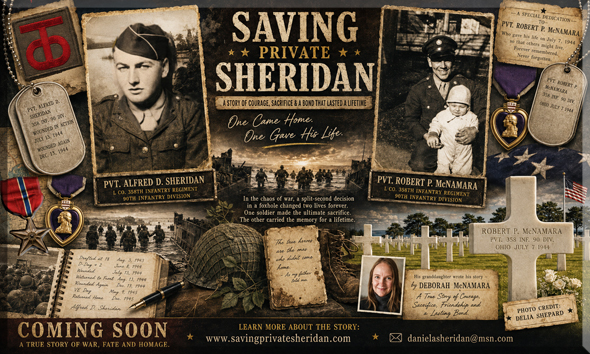
 My father, Alfred D. Sheridan, was drafted at the age of 18 on August 3rd, 1943 and went on to serve in L Company, Third Battalion, 358th Infantry of the 90th Division. His division landed on Utah Beach in Normandy on D-Day Plus 2 (June 8th, 1944).
On July 5th, 1944, he was assigned as a replacement to L Company of the 358th Infantry Regiment. [Special thanks to Christian Levraufre, President of Normandy 44 for providing me with the Morning Report!]
He was wounded at The Battle of Hill 122 on the Cherbourg Peninsula on July 13th, 1944. He received a Purple Heart and a Bronze Star Medal for "Meritorious Achievement in Ground Operations Against The Enemy on or about July 13th, 1944." and returned to the front on August 13th, 1944.
The 90th Division slowly made it's way across France towards the border with Germany crossing the Moselle River in November 1944. He was again wounded on another 13th - December 13th, 1944 during fighting along the Siegfried Line - the heavily fortified German line of defense along its border with France.
When he returned to the front for the second time, my dad thought his number was up and did not look forward as the 13th of another month approached. The War in Europe ended on his birthday - May 9th, 1945 - VE Day. His division then made preparations to be transferred to the Pacific to fight the Japanese, but the war ended in August 1945 and he eventually returned home to the Bronx in December 1945.
A Tribute to Pvt. Robert P. McNamara of The 90th Infantry Division
This website is dedicated to Pvt. Robert P. McNamara, and to the veterans of the 90th Infantry Division who fought in World War II. The red T-O of the division patch originally stood for Texas-Oklahoma, but the 90th soon became known as the Tough 'Ombres.
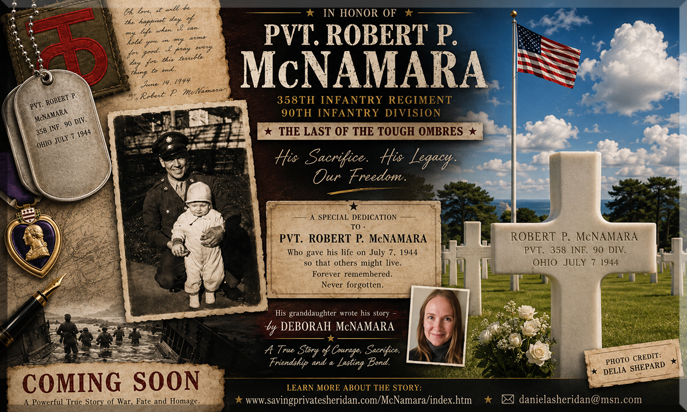
Robert Patrick McNamara — L Company, third battalion, 358th Infantry Regiment, 90th Division
80 Years + Three Generations Later: A Tale of Love, Fate and War
Granddaughter of Pvt. Robert Patrick McNamara Sr.
who died in action on July 7th, 1944.
It was June 1944. My grandfather, Robert Patrick McNamara Sr., was in training when the 90th Division, 358th Infantry, landed on Utah Beach on D-Day Plus 2, June 8th. He was soon to be sent across the English Channel to join these men, just after the initial invasion. When the Third Battalion, 90th Division waded waist deep amidst choppy waters to reach the French beaches, they found ruined boats and shell holes. There had been hundreds of vessels extending as far as the eye could see. The 90th Division Association Battle History reported that along the sandy road that the soldiers followed inland there were empty ammunition cases, discarded packs, helmets and pieces of clothing.
The “Morning Reports” from L Company (my grandfather’s company in the 90th Division), reported that the day they’d landed on Utah Beach the men had marched six miles, eventually making their way north and east to Turqueville, France. Two days later, the first two men in their battalion were killed. By June 14th, six days after landing on Utah Beach, 26 more had died. That same day, Robert wrote a letter home. “Oh love, it will be the happiest day of my life when I can hold you in my arms for good. I pray every day for this terrible thing to end.” Within a few weeks, nearly 90% of the men in Company L would be killed, himself included.
A Tribute to Henri Levaufre & The 90th Division Association
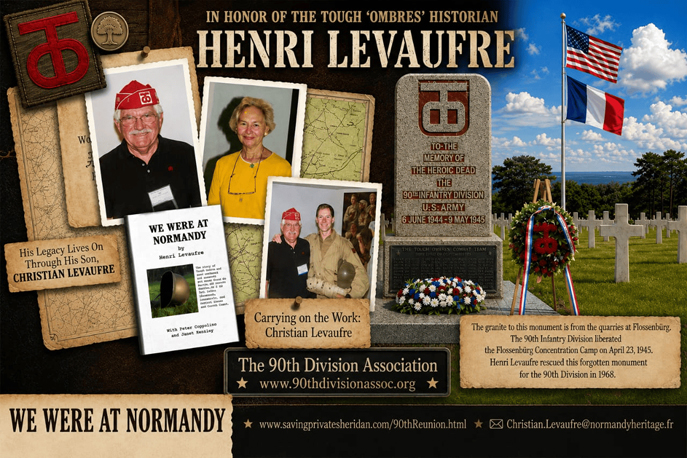
Back in 1968, Henri Levaufre helped rescue the 90th Division Monument, according to an article by Amelia Abney, The 90th ID at Utah Beach, In Memory of ‘Patton’s Favorite’Division.
At the end of the War, soldiers from the 90th Infantry Division chipped in together to have a monument dedicated to their fallen comrades. At the time, they were stationed in Weiden, Germany, after V-E Day on May 9, 1945.
— The granite for the “stele” came from the quarries at Flossenbürg.
— The 90th Infantry Division liberated the Flossenbürg Concentration Camp on April 23, 1945.
[A "stele" is a tall, upright stone slab used in the ancient world as a monument, grave marker, or boundary sign.]
[Special thanks to Christian Levraufre, President of Normandy 44 for carrying on the work of his father and brother! Click here to visit: Normandy 44 ]